

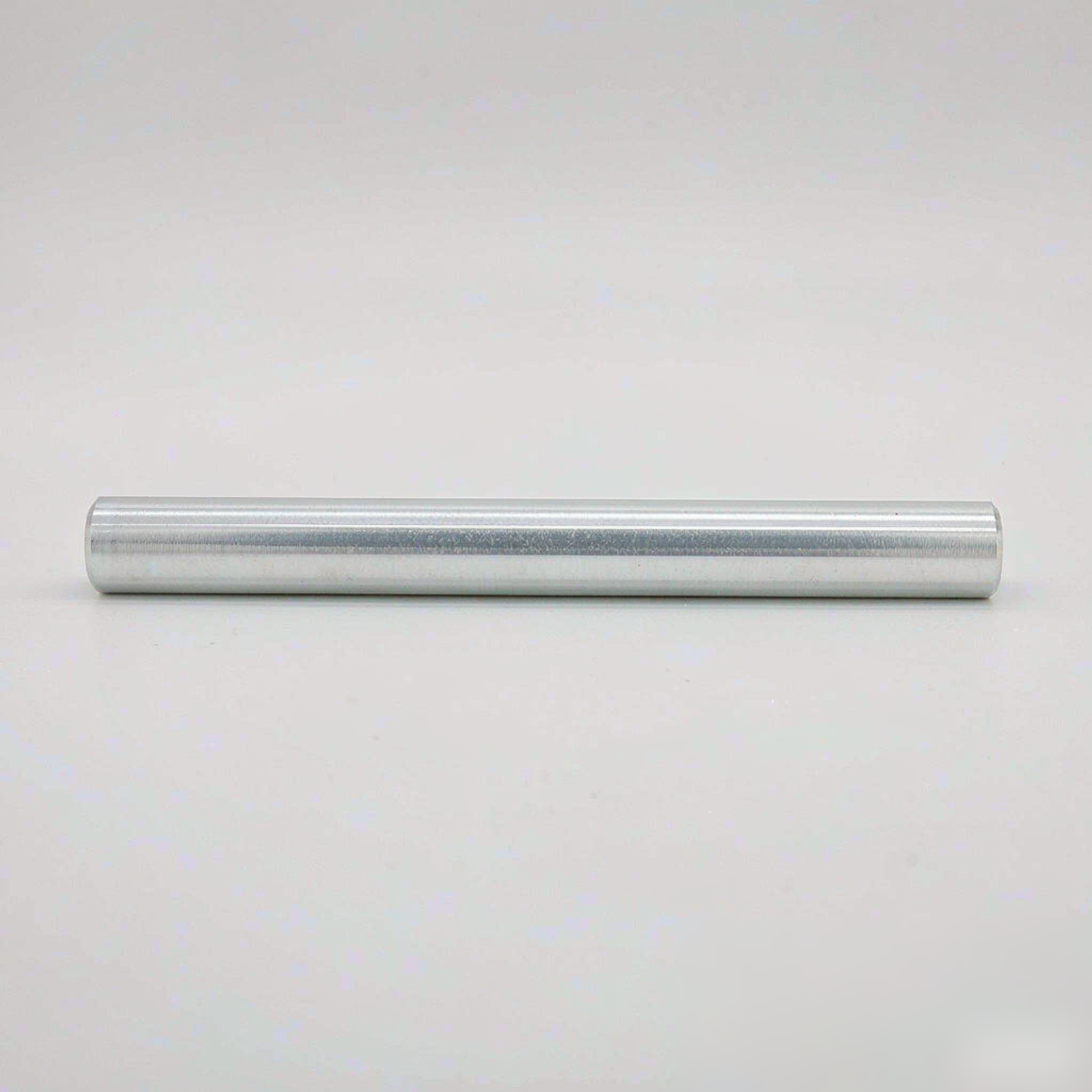
Description (English)
FAQ Q: What is the difference between 2618 and 2618A? A: Both share the same nominal Al-Cu-Mg-Ni-Fe composition. 2618A has tighter impurity limits (lower Si) and a trace Ti addition for finer grain structure and higher thermal strength. Q: What is 2618A equivalent to in Chinese standards? A: 2618A corresponds to 2A80 (LD8) forged aluminum in the Chinese GB/T 3190 standard, and is specified in GJB 3614-1999 for military bar applications. Q: What temperatures can 2618/2618A withstand? A: The alloy retains tensile strength ≥300 MPa at 200–250°C, far exceeding conventional aluminum alloys like 6061, which lose strength rapidly above 150°C. Q: What tempers are available for 2618 round bar? A: Commonly supplied in T6 (solution heat-treated and artificially aged) or T651 (stress-relieved by stretching) condition. Q: Is 2618 weldable? A: Resistance spot and seam welding performance is good. However, arc welding and gas welding performance is poor. For structural welding, TIG or MIG with preheat (150–200°C) and post-weld aging is recommended. Q: What are the standard bar product forms? A: Extruded round bar per ASTM B221 (larger diameters), and rolled/cold-finished bar per ASTM B211 (smaller diameters with tighter tolerances). Q: How does 2618 compare to 2014 and 2024? A: 2618 excels in high-temperature strength (200–250°C), while 2024 offers higher room-temperature strength and 2014 provides good forgeability. 2618 is specifically designed for heat-resistant applications. Q: What surface finishes are available? A: Mill finish, anodized, polished, or machined (peeled/turned) surfaces are available depending on diameter and application requirements.
Size Range
- 8–300 mm
Grade Specification
| System | Value |
|---|---|
| AA 2618 / AA 2618A | - |
| EN AW-2618 / EN AW-2618A | - |
| 2A80 (LD8) | - |
| AlCu2Mg1.5NiFe | - |
| 3.2216 | - |
Chemical Composition
| Element | Value |
|---|---|
| Si | 0.10–0.25 |
| Fe | 0.90–1.30 |
| Cu | 1.90–2.70 |
| Mg | 1.30–1.80 |
| Ni | 0.90–1.20 |
| Zn | ≤0.10 |
| Ti | 0.04–0.10 |
| Al | Remainder |
Mechanical Properties
| Property | Value |
|---|---|
| Tensile strength | 350–520 MPa |
| Yield strength | ≥250 MPa |
| Elongation | ≥10% |
| Hardness | 120–150 HV |
| High-temp strength (200–250°C) | Tensile ≥300 MPa |
Physical Properties
| Property | Unit | Value |
|---|---|---|
| Density | - | ~2.76 g/cm³ |
| Melting range | - | 549–638°C |
| Elastic modulus | - | ~74 GPa |
| Thermal conductivity | - | 146 W/(m·K) |
| Coefficient of thermal expansion | - | 22.5 × 10⁻⁶ /K (20–100°C) |
| Electrical resistivity | - | 0.058 μΩ·m |
Applications
- Internal combustion engine pistons and cylinder heads
- Compressor impellers and blower impellers
- Aerospace engine components (turbine disks, high-temperature structural forgings)
- High-performance automotive engine parts (connecting rods, intake manifolds)
- Die-casting and plastic molds requiring thermal shock resistance